Astor Place
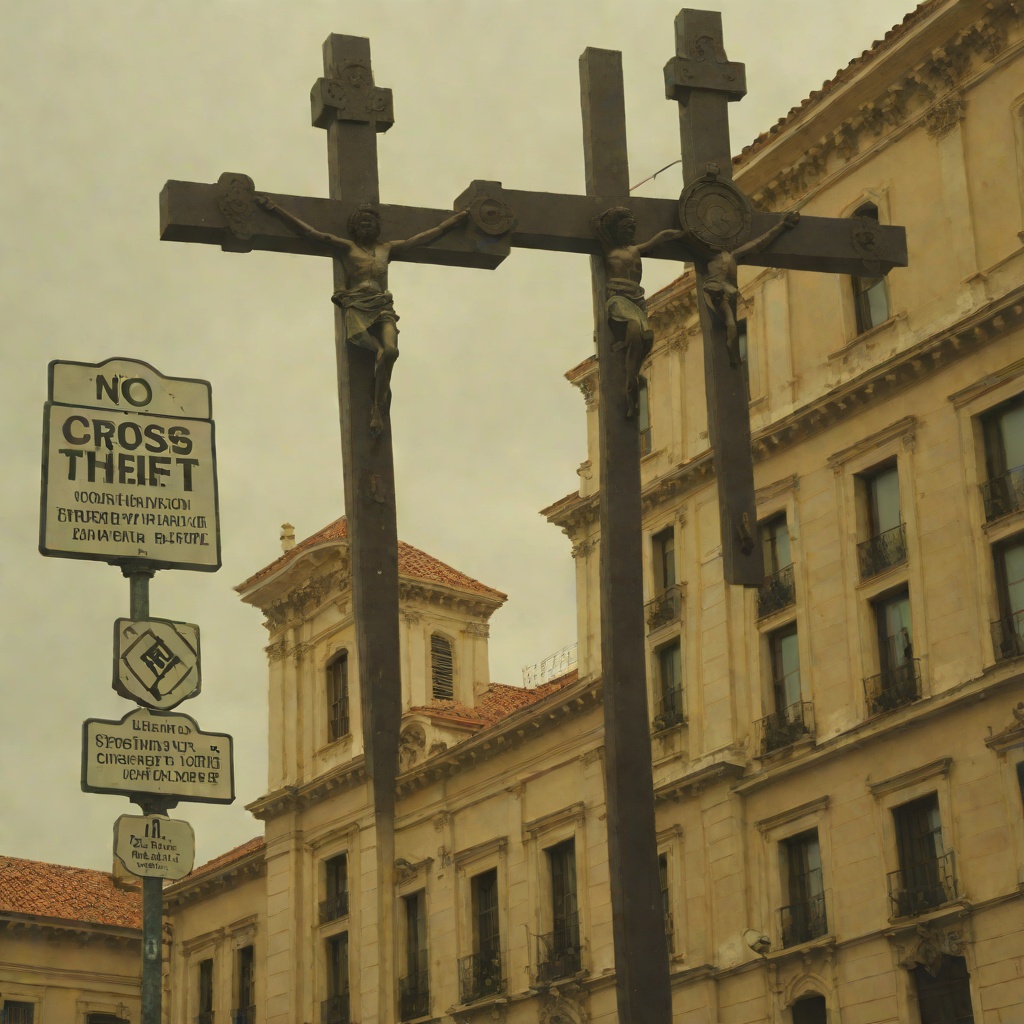
City of GodAstor Place, a public square in Manhattan's East Village, serves as the unlikely marketplace where the novel's central sacred object — the eight-foot hollow brass cross of St. Timothy's Episcopal Church — surfaces in the profane world of street commerce. The square is the site where the narrator, Thomas Pemberton, an Episcopal priest, first encounters the stolen cross in the hands of peddlers who display their goods on the sidewalk, a discovery that collapses the distance between the holy and the mercantile and initiates the novel's investigation into the meaning of sacred objects in a secular city.
The Discovery of the Stolen Cross
Walking through Astor Place in mufti — jeans, a leather jacket over a plaid shirt over a T-shirt, with no cruciform identification — Pemberton spots three purple choir robes neatly folded and stacked on a plastic shower curtain laid out on the sidewalk. He picks one up, turns back the neck, and finds the label: Churchpew Crafts, along with the laundry mark from Mr. Chung. The robes are the vestments of St. Timothy's, and their presence among the peddlers' wares signals that the church's sacred furnishings have been stripped and scattered into the city's informal economy.
The peddler, a solemn young mestizo with a bowl of black hair, wants ten dollars for each robe. Pemberton finds the price reasonable, and his willingness to bargain over the church's own vestments reveals his complicated relation to the institution he serves. Earlier, he had approached another peddler in a choir robe and offered a dollar to see the label; the man's smile dissolved, and he lifted his tray of watches out of reach, saying, "You crazy, mon?" and "Get away, you got no business wit me," looking left and right as he spoke. The peddler's suspicion of Pemberton's interest underscores the illicit nature of the goods and the danger of asking too many questions on the street.
The Cross as Commodity
The appearance of the cross at Astor Place is anticipated by a conversation Pemberton has with a detective about the theft. The detective, a Catholic who attends mass, explains the street logic of sacred objects: thieves will hit a synagogue for the Torah, because it is handwritten and not mass-produced, and it will bring a minimum of five thousand dollars. The book value of the cross, by contrast, is nothing — "scrap metal" on the street, as he puts it. The detective's assessment frames the cross as an object with no market value, which makes its theft all the more puzzling and its reappearance at Astor Place all the more pointed: the peddlers are trying to sell something that, by the logic of the street, is worthless.
Yet the cross does appear among the peddlers' goods, and its presence at Astor Place transforms the square into a threshold between the sacred and the profane. The cross, which had hung behind the altar of St. Timothy's, is reduced to a commodity displayed on a plastic shower curtain, its sacred significance erased by the context of street commerce. The narrator's recognition of the robes and the cross at Astor Place is the first step in a larger investigation that will lead him to the roof of the Synagogue of Evolutionary Judaism, where the cross has been placed, and to a confrontation with the meaning of sacrifice and atonement.
The Square as a Site of Urban Exchange
Astor Place functions in the novel as a representative site of New York City's street economy, where objects of all kinds — watches, robes, and sacred furnishings — circulate without regard for their origins or meanings. The peddlers who sell the choir robes are part of a larger network of informal commerce that operates in public spaces throughout the city, and their goods are anonymous, stripped of the contexts that gave them value. The square's role as a marketplace for the church's vestments and the cross underscores the novel's broader meditation on the commodification of the sacred in a secular age.
The narrator's own position at Astor Place is that of an observer who is also a participant: he is a priest in mufti, unrecognizable as a clergyman, and his attempts to inspect the robes and the cross are those of a man trying to recover something that has been lost. His failure to reclaim the cross at Astor Place — he does not buy it, does not confront the peddlers, does not reveal his identity — sets the stage for the cross's eventual appearance on the roof of the synagogue, where it will be seen not as a commodity but as a sign.
The Square in the Novel's Geography of Meaning
Astor Place is one of several Manhattan locations — including the Upper West Side, the East Village, and the Lower East Side — that anchor the novel's exploration of the city as a landscape of overlapping sacred and secular geographies. The square's position at the edge of the East Village places it at a crossroads of immigrant and bohemian cultures, a fitting location for the appearance of an object that has been uprooted from its institutional home and set adrift in the city's flow of goods and meanings. The discovery at Astor Place is the novel's first indication that the cross's journey is not merely a theft but a displacement, and that its final destination will be determined not by the church but by the city itself.
The square thus serves as the point of origin for the novel's central mystery, the place where the sacred object first enters the profane economy and where the narrator first glimpses the possibility that the cross has been taken not for its value but for its meaning. The peddlers' robes, the laundry mark of Mr. Chung, the plastic shower curtain — these details accumulate at Astor Place to form a picture of a city where even the most sacred objects are subject to the laws of exchange, and where the recovery of meaning requires a journey through the streets.